
Ryusenji / Ryusen Temple is the said to be the home of papercut ‘Goshuin’. A ‘Goshuin’ is a stamp or seal that you can receive for a fee at temples and shrines in Japan. What makes Ryusen-ji’s so special is that they are intricately cut from paper, like a stencil. Ryusenji was the very first place in all of Japan to offer these unique, beautiful papercut seal stamps. As always happens with a ‘good idea’, many have copied their idea, but few have emulated their exquisite temple seal stamps. This temple also has hanachozu periodically.
Ryusenji Temple

Ryusen-ji Temple, or Saitama Yayuyoke Kaiun daishi Ryusen-ji, is one of the three great 「日本三大厄除け開運大師」yakuyoke kauin daishi temples in all of Japan. Moreover, its the only one (of the big three) in Kanto / the Greater Tokyo area. Yakuyoke Kaiun Daishi temples are temples that simultaneously ward off misfortune AND welcome great luck. This is because the temple has two “Daishi” enshrined. A Daishi is like a “Saint” or “Great Teacher”. Ryusen-ji enshrines both the ‘Saint’ of yakuyoke, for warding off evil, AND the Saint of Kaiun for bringing in good luck.
Papercut Goshuin
The dual ‘power’ makes a significant temple and a truly special, spiritual place of worship in Saitama Prefecture. In addition, the benevolences of the temple make it a popular place for ‘Hatsumode‘ in the Kanto region. People literally come from all over the country to pray at the temple over the New Year period. Especially in recent years, as now you can also pick up a limited edition papercut seal stamp during the New Year period. In fact, their limited papercut seal stamps are popular throughout the year as the temple is widely recognized as being the birthplace of these intricate stencil like temple seals.
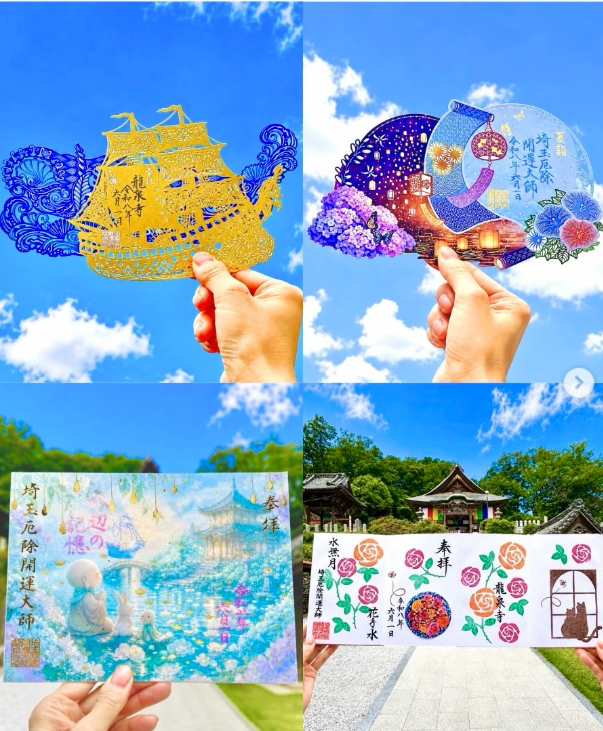
For many years there were two goshuin available each season, but in 2026 they will actually have different ones in the summer months. The 2026 June versions are pictured above, from their Instagram account. They are on sale, subject to availability, from June 1st to June 30th. And even though they make thousands of them, they do run out! They also end up on online sales websites! You can only purchase them between 9 am and 4 pm between Wednesdays and Mondays. They don’t sell them on Tuesdays. Please note to buy the Goshuin / Stamp Book (not the stamp) requires entering a lottery to purchase.
Cherry blossom season
There is an early blooming kawazu cherry blossom in the precincts. It typically blooms around the end of February to early March. You can see it in the tweet from the temple, with a stunning cherry blossom goshuin, from March 1st 2020.
Daruma Ema (Prayer Plaques)

Daruma or daruma dolls are a type of wooden doll modeled on Bodhidharma, a legendary Buddhist Monk often called the father of Zen Buddhism. Takasaki in Gunma Prefecture is famous for Daruma, but there are many places you can see Daruma around Japan. There are also plenty of places where you can see daruma emblems emblazoned on prayer plaques, called ema in Japanese. However, prayer plaques that are the color of AND in the shape of Daruma (pictured above) are quite rare.
Daruma Market
The temple also has a daruma market each year at New Year’s. The official festival period (with stalls and markets) of New Year is longer at Ryusenji than most temples, from the 1st to the 12th. It is estimated that approximately half a million people visit the temple for their first prayers of the New Year.
Hanachozu


There are three hanachozu near the shrine’s offices. They change the flowers seasonally. They make a nice background for contrasting the goshuin.
Lanterns

There are beautiful red and white lanterns hanging in both the temple’s gates all year round.
Information
Event: Ryusenji Limited Edition June 2026 Goshuin 龍泉寺の秋限定切り絵御朱印
Date: from June 1st to 30th (not available on Tuesdays)
Time: from 9 am to 4 pm
Cost: from 1300 yen
Venue: Saitama Yakuyoke Kauin Daishi Ryusenji (Ryusen-ji) 埼玉厄除け開運大師-日本三大厄除け開運大師・龍泉寺, 3712 Mikajiri, Kumagaya, Saitama 360-0843. View on Google Maps.
Access
The temple is about a 20 minute walk from Aketo Station on the Chichibu line. It takes about 40 to 45 minutes on foot from Kagohara Station. There is parking for about six cars directly in front of the temple’s gates as well as several other parking lots, of which the largest – about a two minute walk away – fits about 200 cars!
(Last full republish June 8th 2023)
beautiful!